
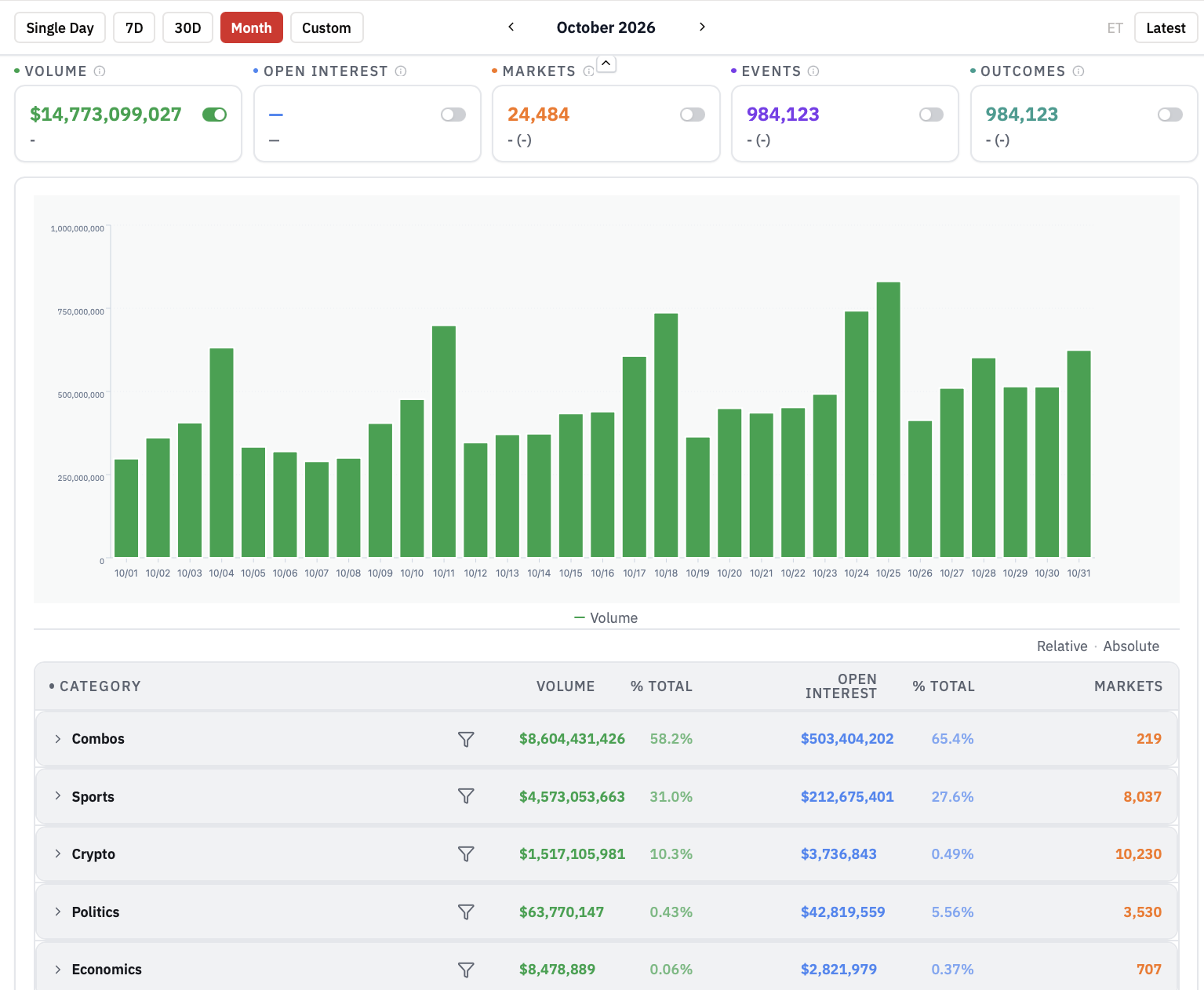
Cointelegraph reported on November 11, 2026 that trading on Polymarket’s US exchange more than tripled between June and October, up about 266%. Monthly volume rose from $4.04 billion to $14.77 billion, according to analytics platform TickerTracker. The report said TickerTracker counts trades at the contracts’ full payout value.
Polymarket told CNBC on Tuesday, as that article dated the comment, that annualized revenue had topped $1.8 billion, up from more than $1 billion in June.
Where October’s volume was concentrated
Combo contracts, which bundle multiple predictions into a single wager, accounted for $8.6 billion, or 58.2%, of October’s volume. Sports contracts were the next-largest category at $4.57 billion, or 31%. On the breakdown Cointelegraph published, those two categories made up most of the month.
The US arm had grown rapidly since the company widened access in May. Polymarket began admitting US traders to the separate exchange in late 2025, three years after a settlement with the Commodity Futures Trading Commission led it to block US trading on its international platform. States were challenging whether federally regulated prediction markets can offer sports contracts without state gambling licenses.
Sports first, politics on a much smaller base
The increase also followed a surge in sports-related trading during the FIFA World Cup, which the report said ran from June 11 to July 19. Soccer contracts generated $1.81 billion in trading volume in June, up from $85.4 million in May, according to TickerTracker.
Political markets saw more activity around the US midterm elections, but from a much smaller base. Election-related contracts generated $108.2 million on the US exchange during the first 10 days of November, compared with $16.6 million throughout September. Despite that increase, political markets accounted for just 2.2% of the platform’s November trading volume. The November election figure covers only the first 10 days, not a full month.
A reported financing, beside unresolved cases
Polymarket was pursuing a $1 billion funding round at a reported $21 billion post-money valuation. Investment firm 1789 Capital, where Donald Trump Jr. is a partner, was reportedly leading the round with an expected contribution of about $300 million. Cointelegraph presented the round, the valuation, and the expected contribution as reported rather than as a completed deal.
The volume figures did not, in that account, resolve the regulatory disputes. The CFTC was reportedly investigating Polymarket earlier in 2026. In June, US Senators John Curtis and Adam Schiff separately called on the regulator to examine allegations that the company paid social media influencers to promote fabricated trades. The article presents those claims as allegations, not as established findings. Polymarket told Cointelegraph it was “conducting a comprehensive audit of active promotional content to ensure it complies with our standards, as well as applicable regulatory and legal disclosure requirements.”
In September, New York Attorney General Letitia James sued the company, alleging that its sports-related event contracts violated state gambling laws. Cointelegraph described the lawsuit as part of a broader wave of state actions against prediction-market platforms, including Kalshi, over whether the contracts fall under federal commodities regulation or state gambling laws.
The CFTC has defended its authority to regulate prediction markets and was pursuing legal action involving 10 states over efforts to enforce state gambling laws against the platforms. The report said the jurisdictional dispute could ultimately reach the US Supreme Court. In September, New Jersey officials petitioned the court to hear their case against Kalshi, seeking a ruling that could clarify which authorities have jurisdiction over sports-related prediction markets.
The same article also pointed to a related Cointelegraph report that Binance and Polymarket were seeking a Polygon hard fork to recover $6.8 million in stolen crypto. That matter was not developed in the volume story.
What the November 11 report documents is a sharp rise in reported US-exchange volume, concentrated in combo and sports contracts, a revenue figure the company gave CNBC, and a valuation still described as reported. It does not show that the state or federal challenges had been decided in Polymarket’s favor, or that the influencer-payment allegations had been proved. Full-payout volume, as TickerTracker’s method is described in the piece, is also not the same figure as cash staked or as profit.
Source: Cointelegraph, November 11, 2026