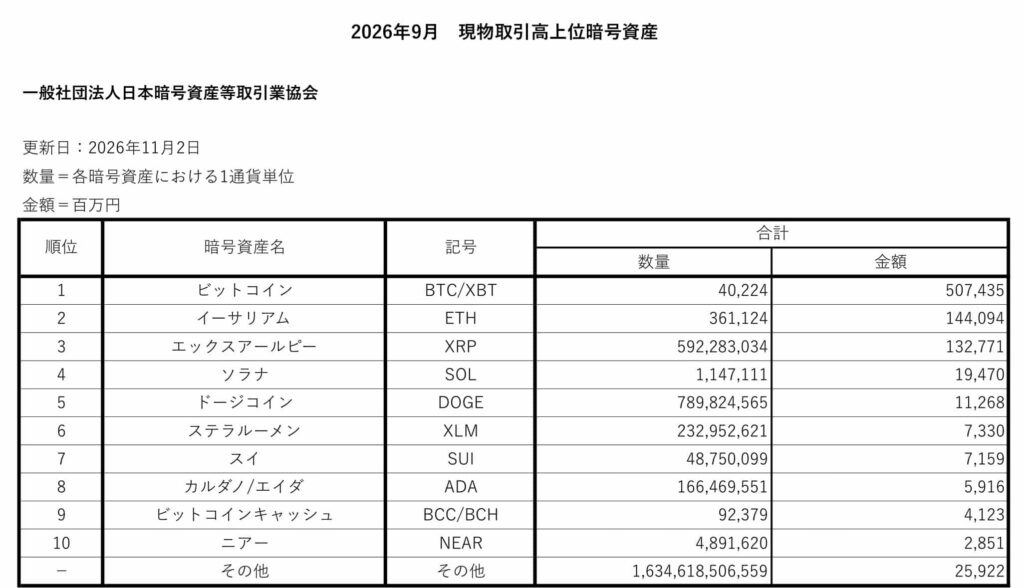
A November 23, 2026 report said XRP was Japan’s third most traded crypto asset in September, behind only Bitcoin and Ethereum. The ranking is from the Japan Virtual and Crypto assets Exchange Association (JVCEA), the industry body for the country’s licensed exchanges. Its monthly tables count spot trades, in which users buy and sell the coin itself.
JVCEA reported ¥132.8 billion in XRP spot trading for September, equal to 592 million XRP. The report converted that total to about $850 million at September’s average exchange rate. A same-day post from Uphold Markets cited the same yen figure and put it at about $880 million, so the dollar translation of the JVCEA total is not a single settled number.
September’s top five by yen spot volume were:
- Bitcoin: ¥507.4 billion
- Ether: ¥144.1 billion
- XRP: ¥132.8 billion (592 million XRP)
- Solana: ¥19.5 billion
- Dogecoin: ¥11.3 billion
XRP’s yen volume sat close to Ether’s and was almost seven times Solana’s. The gap after the top three was large.
A larger share of a smaller market
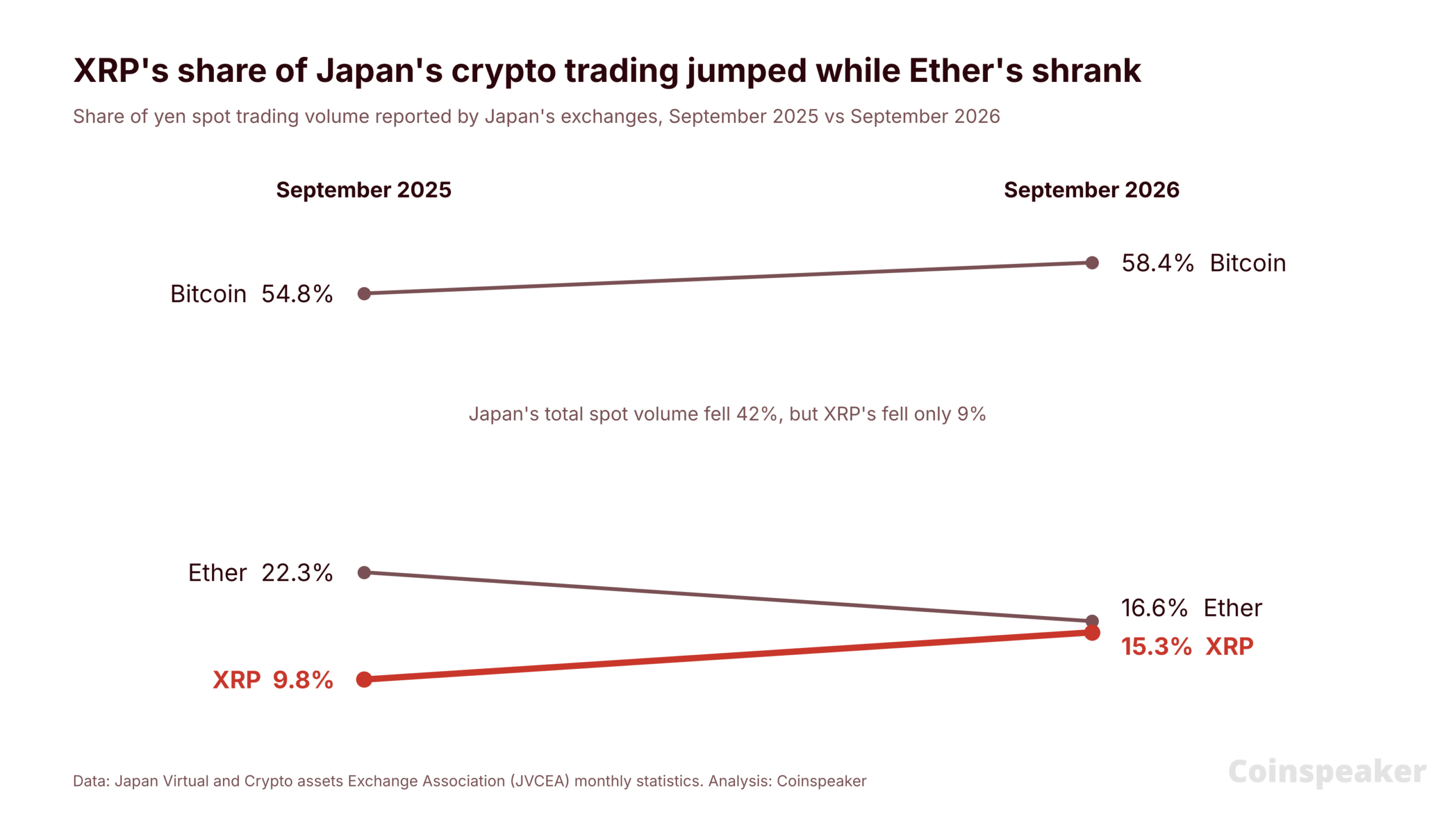
Set against JVCEA’s September 2025 tables, total spot trading on Japan’s exchanges fell from ¥1.49 trillion to ¥868 billion, a drop of 42%. Ether’s volume fell 57%, Bitcoin’s 38%, and XRP’s 9%. XRP’s share of that smaller market rose from 9.8% to 15.3%.
Counted in coins, traders exchanged 592 million XRP, against 339 million a year earlier — about 75% more coins. The report says much of that increase reflects the lower price: each coin was worth far less.
In Japan, XRP traded about ¥92 for every ¥100 of Ether in September. On Binance’s dollar-stablecoin pairs that month, the report said XRP traded only about $33 for every $100 of Ether. The concentration shows up in the Japanese spot tables. It was not matched on that global venue.
The report treats XRP’s local standing as long-running rather than a new catalyst. SBI Holdings, a large Japanese financial group and one of Ripple’s oldest partners, runs the exchange SBI VC Trade. That is background for why XRP has long been popular in Japan, not evidence that September’s rank changes the token’s price.
What the price was doing
As of the November 23 report, price had not followed the rise in share. On the outlet’s count of monthly prices from Yahoo Finance, XRP was down 25.5% in November so far. That was already deeper than its previous worst November, a 23.6% drop in 2019, and the month was not over. On that count, 2026 had seven losing months out of eleven, with November still underway.
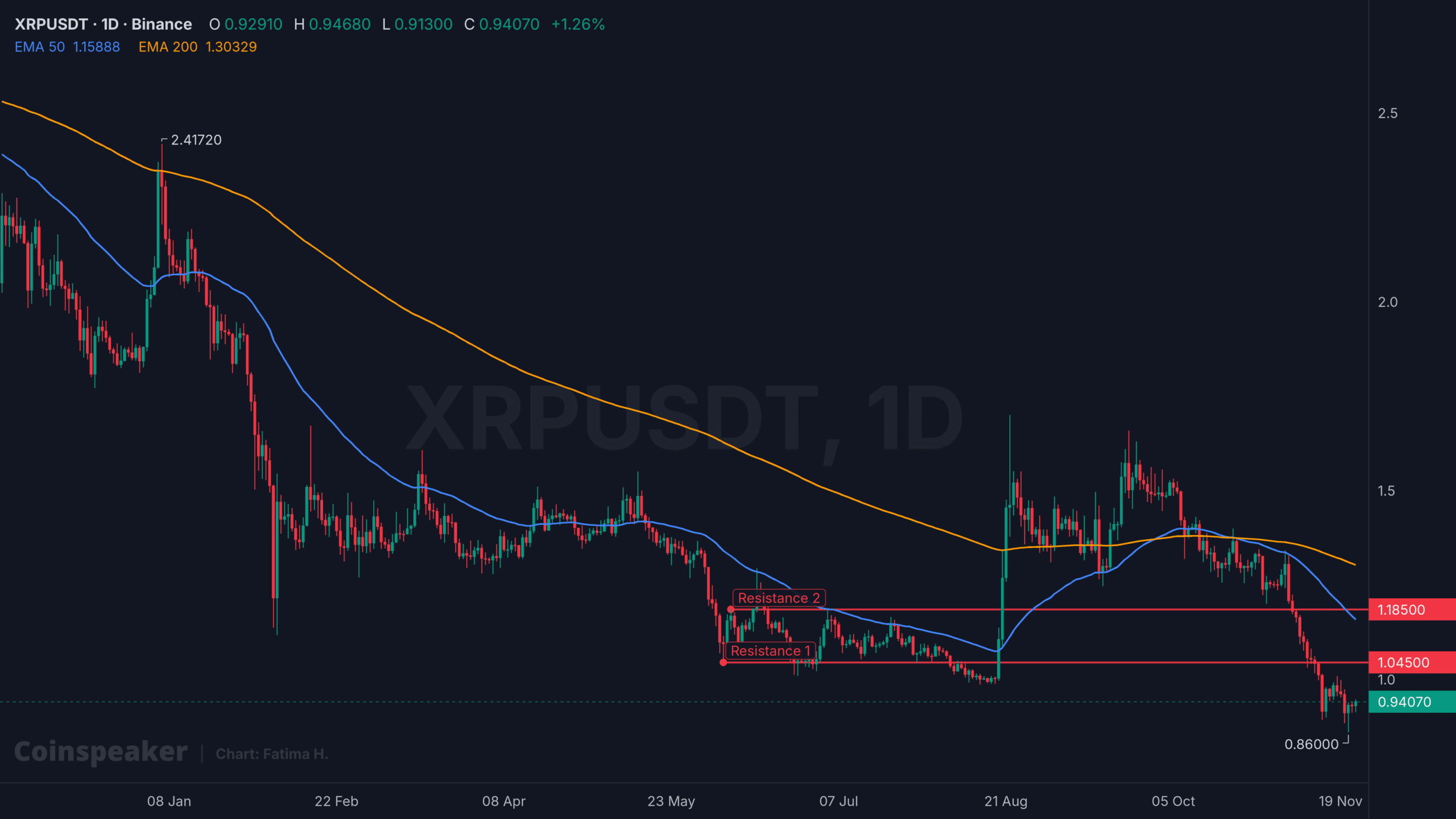
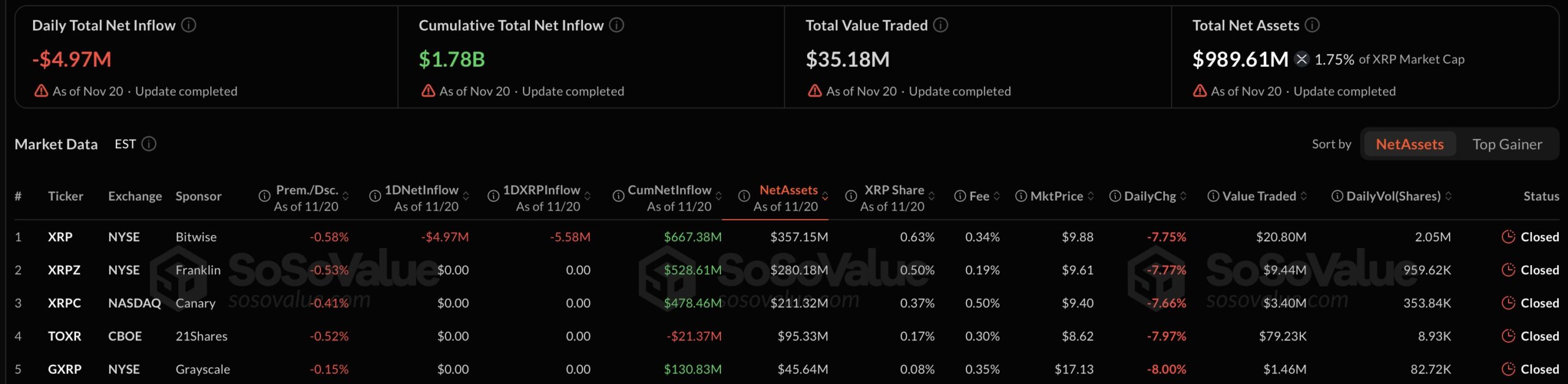
US spot XRP funds had lost about $26 million in November to that point, according to SoSoValue. Those are reported fund flows, not a measure of Japanese spot demand.
At the time of the report, XRP traded at $0.941, below its 50-day exponential moving average at $1.16 and its 200-day exponential moving average at $1.30. It hit $0.86 on November 21, its lowest price since November 2024.
The outlet identified $1.045 — described as the June-to-August floor, then acting as a ceiling — as the first level a rebound would need to clear on a daily close, and $1.185 as a further level where XRP turned lower in June and July. It marked $0.86, the November 21 low, as support. Its scenario table also pointed to $0.60–$0.70 if price closed below $0.86, a zone tied to trading before the November 2024 breakout. Those are conditional levels in a technical write-up, not observed results, and not a showing that Japanese volume will produce them.
The JVCEA figures are narrower than a recovery claim. XRP’s yen turnover was still down from a year earlier, while Japan’s overall spot market was down much more. A higher share of a shrinking market, and more coins changing hands at a lower price, coincided with a November that was already worse than 2019’s. The report itself ties any recovery first to price getting back above $1.045. The September ranking does not show that this had happened.