
Polymarket opened markets on the on-demand rental rates of Nvidia’s H100, B200 and B300 GPUs, founder and CEO Shayne Coplan announced on November 26, 2026. The contracts extend through December 2028. Coplan likened the result to a “yield curve for the cost of compute,” arguing that labs buying GPU time, cloud providers selling it and lenders financing the hardware all need a way to hedge future rents.
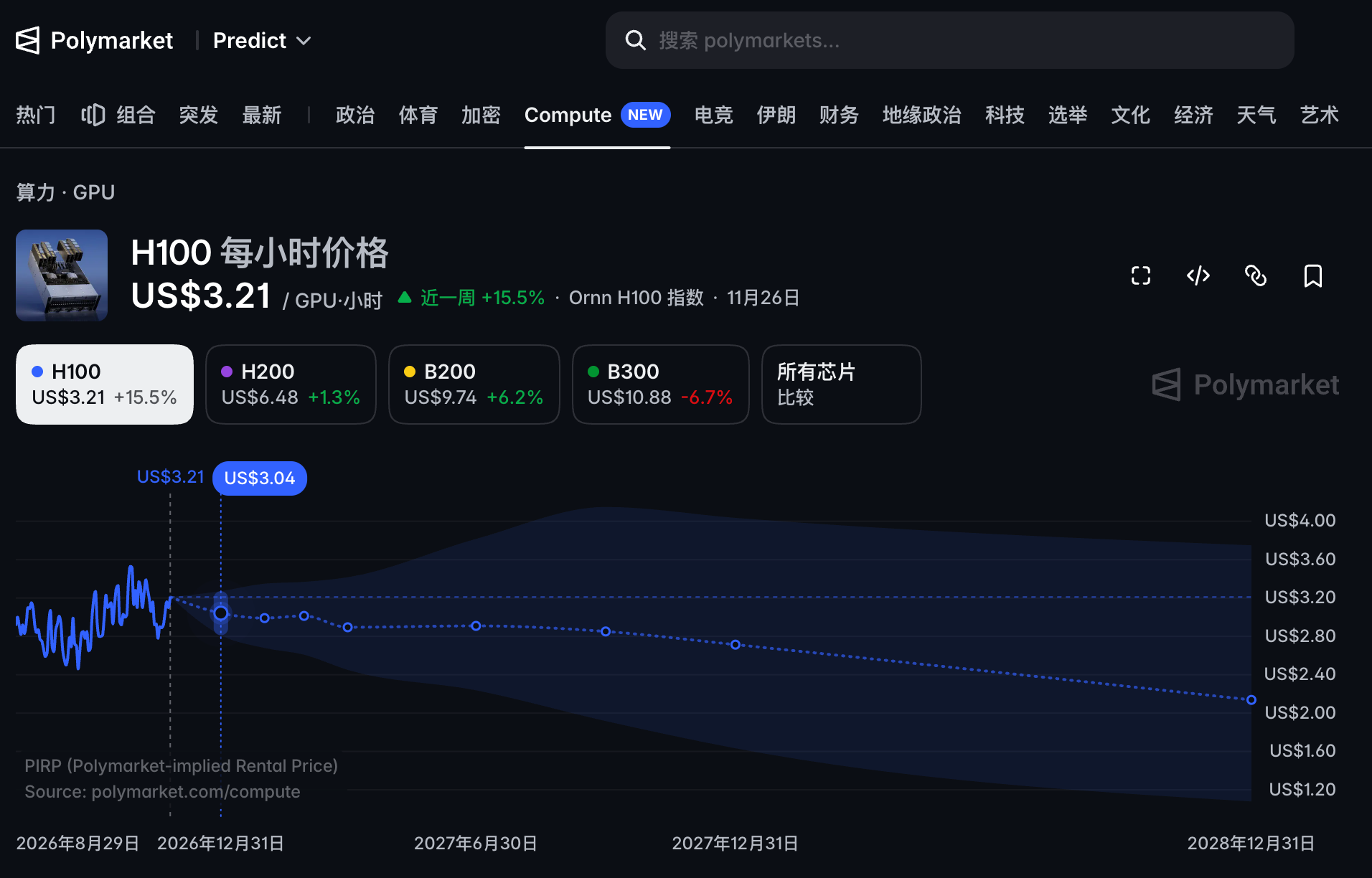
The early curve implied an H100 rental rate of about $2.14 per GPU-hour by the end of 2028, more than 30% below the roughly $3.21 shown by the Ornn index at the time of reporting. That gap measures what traders expected, not a decline that had already occurred. Nor could a lab reserve an hour of H100 capacity at $2.14: the contracts settle in cash.
How a yes-or-no contract produces a rental estimate
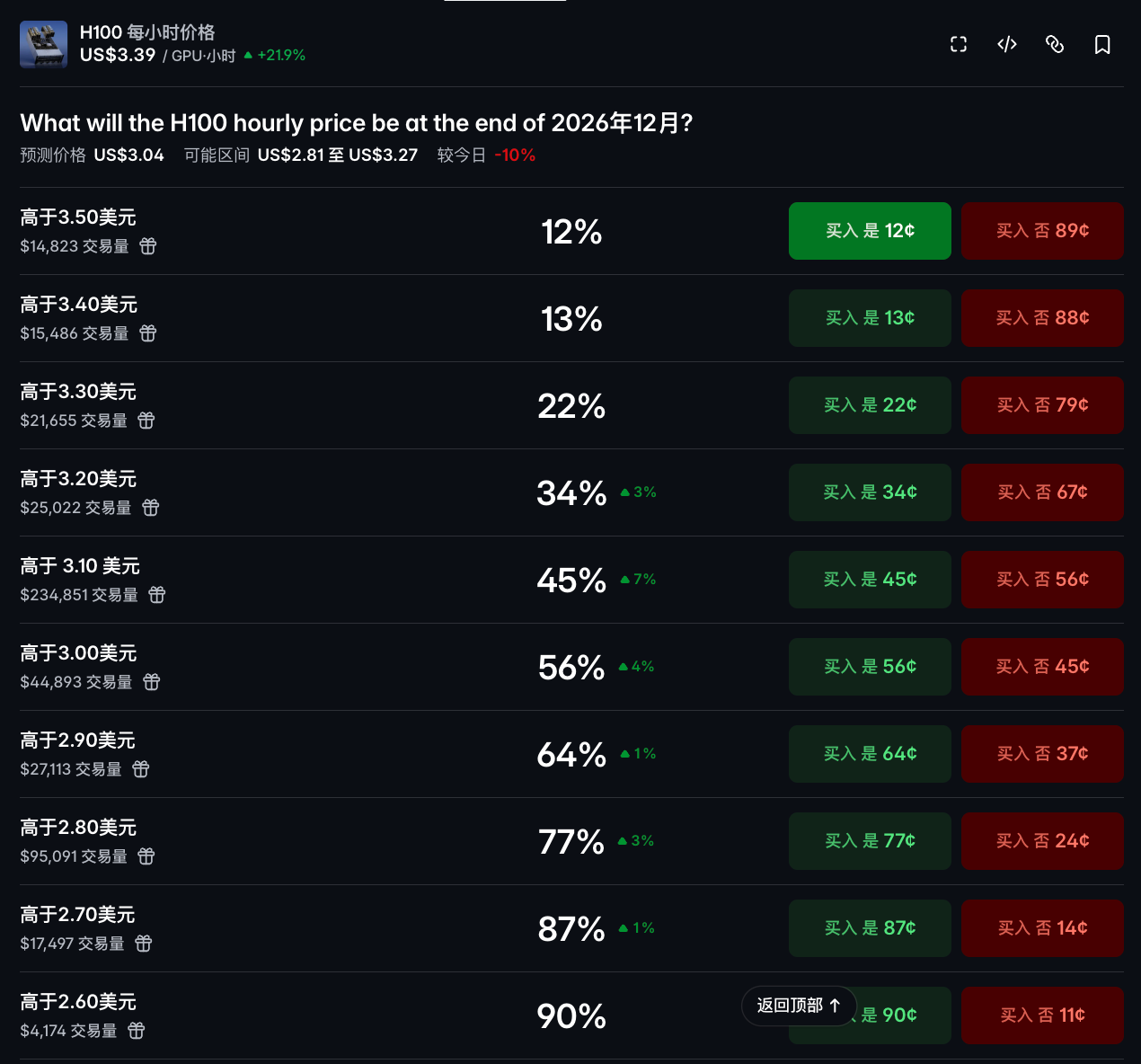
One contract asks whether the average H100 rental rate in December 2026 will exceed $3 per GPU-hour. Polymarket uses the probabilities implied by trading at several such thresholds to estimate a rate for the month. Repeating that calculation across months produces the forward curve.
Settlement uses the OCPI benchmark, which draws on completed on-demand rentals rather than cloud providers’ list prices and is available on the Bloomberg Terminal. Alongside the H100 reading, the Ornn index showed rates of about $6.48 per GPU-hour for the H200, $9.74 for the B200 and $10.88 for the B300. The Bittensor GPU rental platform lium.io showed lower rates than the corresponding index readings, a reminder that the benchmark is not the price every renter pays.
Early trading also limits how much weight the curve can bear. Individual prediction markets recorded volumes in the tens of thousands of dollars, while reported volume for an H200 price prediction was only a few hundred dollars. Polymarket also outlined plans for perpetual products, but those were not open for trading.
What the curve can tell a lender
Cloud providers that borrow to buy GPUs depend on rental income to service their debt. A sustained fall in rents could squeeze their cash flow while putting pressure on the value of the GPUs pledged as collateral. A public curve gives borrowers and lenders a reference point for discussing those risks in a business where many prices are negotiated privately.
Coplan said hundreds of billions of dollars in compute purchases and financing commitments had been locked in years ahead, describing those deals as leveraged bets on future GPU rents. There is some evidence of demand for a hedge: in June 2026, Polymarket, digital-asset prime broker FalconX and AneraLabs completed a six-figure institutional block trade tied to the Ornn H100 index to hedge compute-cost risk. Coplan has invited institutions to discuss large trades and positions spanning multiple months.
Polymarket was not the first to publish such a curve. Kalshi launched Ornn-settled rental predictions covering the H100, H200, B200, A100 and RTX 5090 in March 2026 and published market-implied forward curves in July. CME Group had plans for H100 and B200 futures based on Silicon Data indices, while ICE was developing Ornn-linked contracts. Those plans were distinct from the prediction contracts already trading.
For a lender valuing future rental income, the key limitation is what the index measures. Much of the industry’s contracted revenue comes from multiyear reservations, while the benchmark tracks on-demand transactions. The two rates need not move together. The curve makes traders’ assumptions visible; whether it becomes a reliable reference for financing depends on deeper trading and on whether compute buyers, sellers and lenders trust the benchmark.