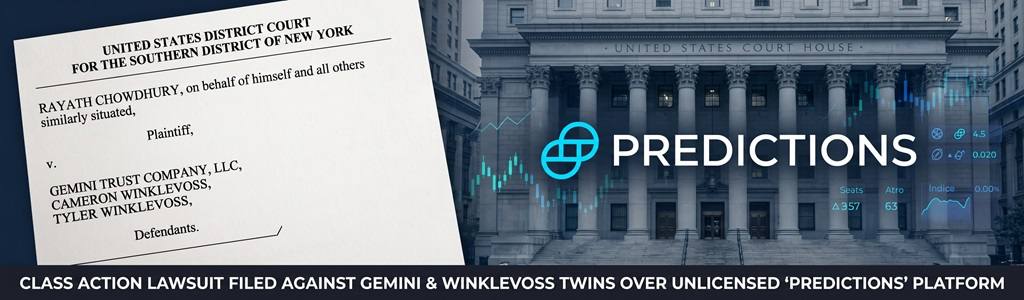
New York resident Rayath Chowdhury filed a proposed class action on November 25, 2026, alleging that Gemini Predictions operates as an unlicensed sportsbook. Chowdhury says he began placing bets and losing money on the platform’s sports event contracts around May 19. He seeks to recover money wagered by users nationwide.
The complaint, filed in the U.S. District Court for the Southern District of New York, names six defendants: Gemini Space Station Inc., Gemini Titan LLC, Gemini Olympus LLC, Winklevoss Capital Fund LLC, and Gemini co-founders Cameron and Tyler Winklevoss. As of November 28, the court had not ruled on the complaint or the request for class certification. The allegations remain unproven.
What Gemini calls an event contract
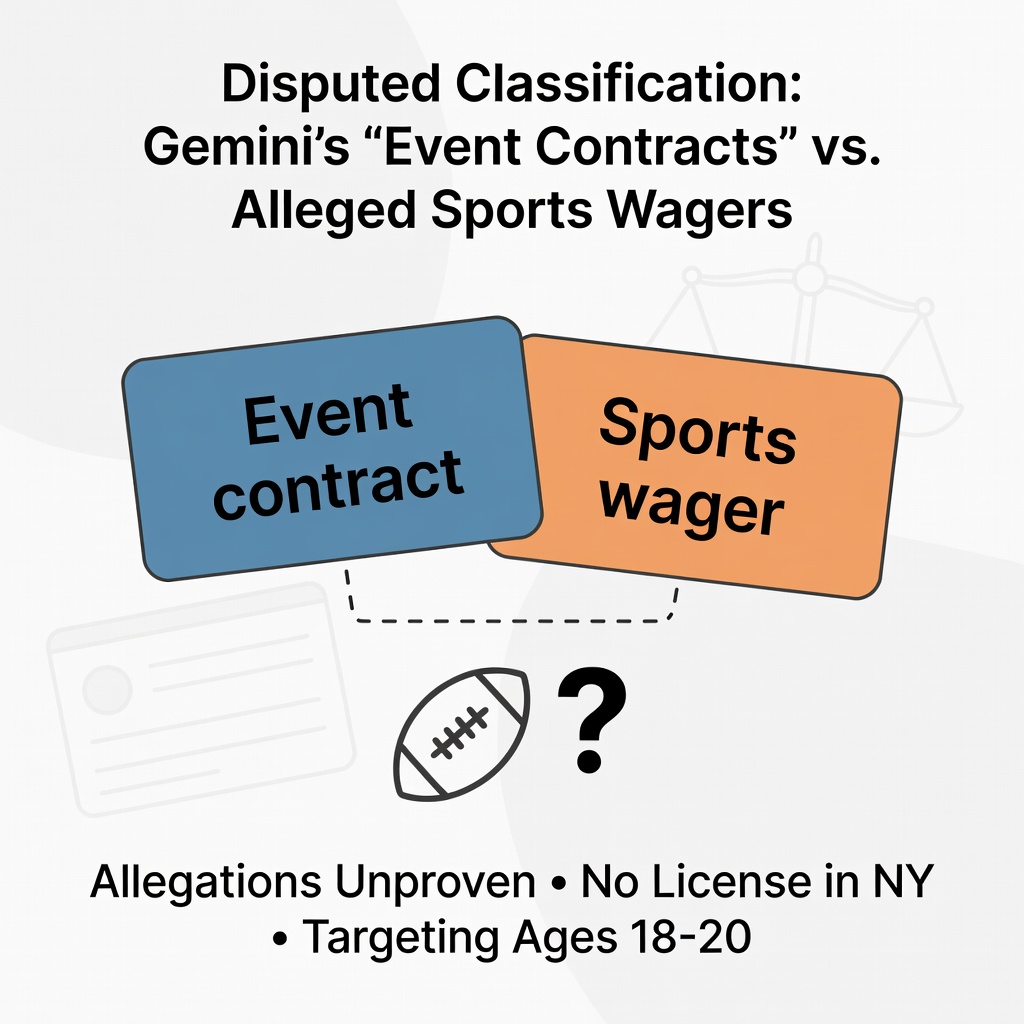
New York, where Gemini is headquartered, requires sportsbooks to hold a state license. Chowdhury alleges that no Gemini affiliate has ever held a license from the New York State Gaming Commission. He argues that Gemini has called sports bets “event contracts” since at least January 8, 2026, to offer them in jurisdictions that prohibit online sports betting. In his account, terms such as “trading,” “predictions” and “combos” obscure the nature of the wager. The platform’s offerings include point spreads on college baseball and basketball games and, starting in September, NFL parlays marketed as “combos.”
The complaint alleges that the platform is accessible across all 50 states and that Gemini uses social media ads, cash promotions and endorsements from its founders to target people aged 18 to 20. That age group is generally ineligible for legal sports betting in New York and other states.
Public reports cited in the complaint estimate that cumulative trading volume reached 100 million contracts in May and 225 million by mid-August, then surpassed 329 million by October 21, 2026, following the platform’s December 2025 launch. Those figures count contracts traded, not dollars wagered or lost.
What the plaintiff seeks to recover
Two of Chowdhury’s five claims invoke Sections 5-419 and 5-421 of New York’s General Obligations Law, which allow bettors to seek recovery of money lost on illegal wagers. Two others allege deceptive practices and false advertising under Sections 349 and 350 of the state’s General Business Law. The fifth alleges unjust enrichment.
Chowdhury proposes a New York class, a nationwide class and subclasses in 29 other states and the District of Columbia. He requests a jury trial, an accounting of bets, restitution, an injunction and treble damages.
The complaint also alleges that the Winklevoss brothers jointly own, fund and oversee the Gemini entities as a single enterprise. Chowdhury argues that hosting the service on Gemini while keeping equity and guarantees in Winklevoss Capital Fund directs revenue to the founders. In May 2026, the fund bought $100 million in new Gemini shares with approximately 1,258 bitcoins, raising the brothers’ beneficial ownership to roughly 65.1% of Gemini’s Class A shares.
Earlier regulatory action
The filing marks Gemini’s second gambling-related case in New York in 2026. On April 21, New York Attorney General Letitia James sued Gemini Titan, alleging it ran an unlicensed wagering business. Connecticut’s consumer protection regulator issued a cease-and-desist order in September, followed by Ohio’s casino control commission in October.
Separately, Gemini’s third-quarter revenue fell 19% year over year to $40.9 million. Asset manager VanEck also decided to discontinue custody and settlement agreements with Gemini for three exchange-traded funds.