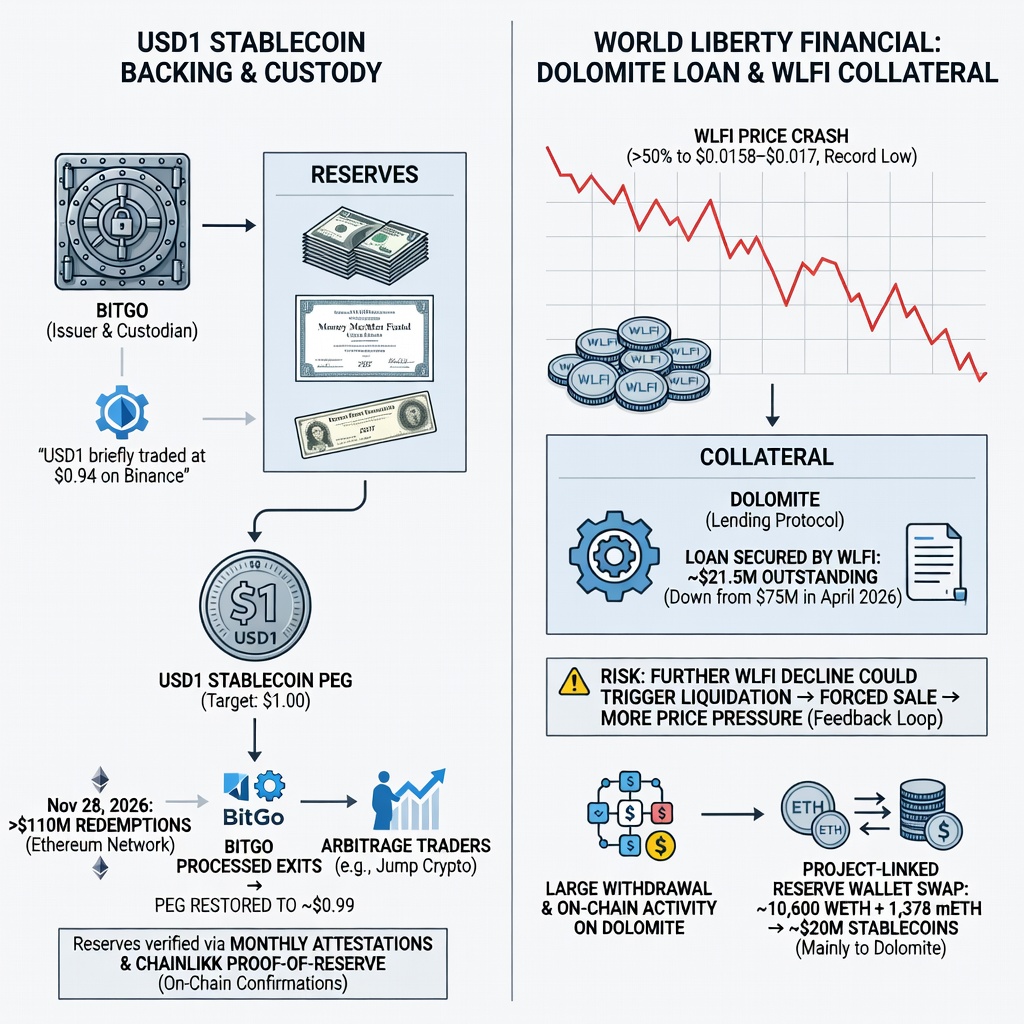
World Liberty Financial’s USD1 stablecoin briefly traded at $0.94 on Binance on November 28, 2026, before recovering to about $0.99. The drop followed a large withdrawal and other activity on Dolomite, a lending protocol where World Liberty owed about $21.5 million on a loan secured by WLFI, its own governance token.
WLFI fell more than 50% to a record low reported at between $0.0158 and $0.017. That decline eroded the value of World Liberty’s loan collateral. It did not directly reduce the value of USD1’s reserves, which hold no WLFI.
The risk in borrowing against WLFI
World Liberty had borrowed approximately $75 million in stablecoins on Dolomite in April 2026, pledging WLFI as collateral. Although the debt was down to about $21.5 million by November 28, a further decline in WLFI could still put the position at risk of liquidation. A forced sale of the collateral could, in turn, put more pressure on WLFI’s price.
A project-linked reserve wallet reportedly swapped roughly 10,600 WETH and 1,378 mETH for about $20 million in stablecoins to avoid liquidation. Most of those stablecoins went to Dolomite.
What the redemptions showed
BitGo, USD1’s issuer and custodian, processed more than $110 million in USD1 redemptions on Ethereum in the 24 hours around the depeg. Arbitrage traders, including Jump Crypto, helped bring the market price back toward a dollar. USD1’s market capitalization had already fallen by approximately $1 billion in the preceding month, to about $2.8 billion.
USD1’s backing consists exclusively of US cash, government money market funds and short-term Treasuries. Monthly attestations cover those reserves, and Chainlink proof-of-reserve confirmations are intended to let holders verify the backing on-chain.
The redemptions showed that BitGo continued to process exits while USD1 traded below a dollar. They did not resolve the separate question raised by the Dolomite loan: how World Liberty manages the risk of borrowing against its own token. Neither the attestations nor the on-chain reserve checks show how closely BitGo monitors those treasury decisions.