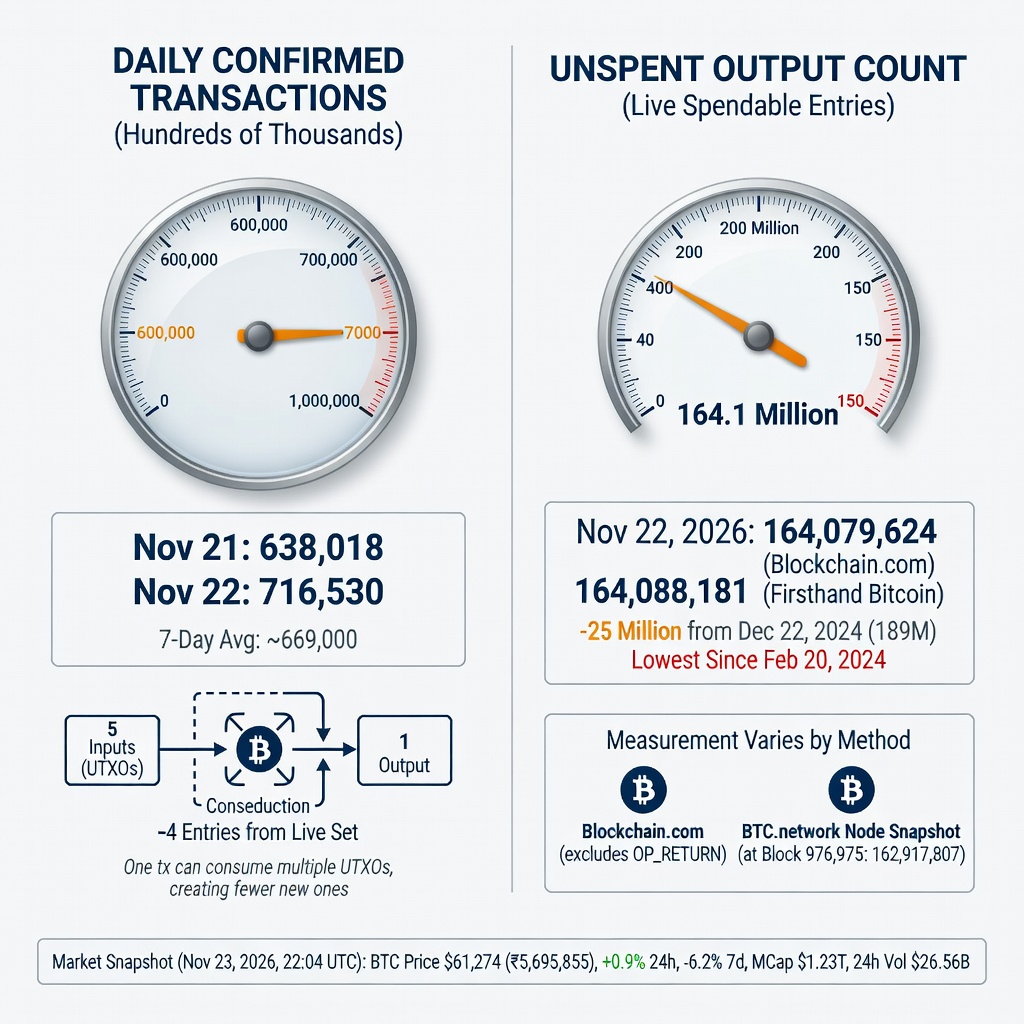
A report dated November 24, 2026, described a smaller live set of Bitcoin unspent transaction outputs even while the network kept confirming hundreds of thousands of transactions a day. On November 22, 2026, the unspent-output count was about 164.1 million, roughly 25 million entries fewer than on December 22, 2024. The count measures spendable entries still available to be referenced, not the amount of bitcoin those entries hold.
Blockchain.com’s series recorded 164,079,624 unspent outputs on November 22, 2026, down 13.2% from 189,085,860 on December 22, 2024. Those readings, and a comparison published by Firsthand Bitcoin, were reported by Cryptoslate. Firsthand Bitcoin used slightly different figures—164,088,181 for November 22 and 189,282,514 for its December 2024 high—implying a drop of 25.2 million and placing the November level at its lowest since February 20, 2024.
Confirmation volume did not show a matching contraction. The network confirmed 638,018 transactions on November 21 and 716,530 on November 22, averaging about 669,000 a day over the seven days through November 22. Over the 30 days through November 21, miners collected an average of 2.84 BTC a day in transaction fees. A separate BTC.network node copy counted 162,917,807 outputs at block 976,975 on November 22.
Why filled blocks can still shrink the live set
An unspent transaction output is a portion of bitcoin a previous transaction left available to spend. Full nodes consult that set to check that a new transaction still refers to funds that exist. One confirmed transaction can consume several outputs and create only one new spendable output, so activity itself can reduce the total. Cryptoslate’s illustrative example is a transaction that spends five separate outputs and creates one new spendable output: it adds one to the daily transaction tally and removes four entries from the live set.
The aggregate figures do not assign the decline to a single cause. Combining many small outputs in one transaction is one plausible contributor, and cheaper fees would make additional inputs less expensive, but the totals leave open how much consolidation contributed. The measurement also varies by method. Blockchain.com’s series counts valid outputs and excludes OP_RETURN outputs, which can carry data without creating a spendable entry. BTC.network’s roughly 162.9 million figure came from a node snapshot at one block, so an exact comparison would need a shared block reference and matching counting rules. Cryptoslate also noted that its source export had no reading for November 15, 2025.
What a smaller count does not establish
Full nodes then have fewer spendable entries to track, but the output count is only one gauge of node burden. Bitcoin Core’s documentation lists the number of outputs and estimated chainstate disk usage as separate measurements. Disk usage, the size of the historical blockchain, the amount of bitcoin those entries represent, and the number of wallets each require their own measure. A smaller unspent-output set does not mean less bitcoin exists.
The market context published with the ledger figures was weak on its own terms and was not presented as an explanation of the output decline. A CoinPaprika snapshot timestamped 22:04 UTC on November 23, 2026, priced bitcoin at $61,274 (₹5,695,855), up 0.9% over 24 hours and down 6.2% over seven days. Bitcoin traded around $61,000 that day, down nearly 24% over 30 days, on the same CoinPaprika data. Market capitalization stood at $1.23 trillion, with 24-hour volume of $26.56 billion.
What later readings would still have to show
Subsequent Blockchain.com series updates and BTC.network node snapshots would indicate whether the count stabilizes near its February 2024 level or continues to drift. Any change in aggregate fee rates would also change how costly further consolidation becomes. As of the November 24, 2026, report, the supported observation is narrower than a story about network growth or contraction: daily confirmations stayed in the hundreds of thousands while tracked spendable entries were well below the December 2024 readings, and the published totals do not isolate how much of that gap came from consolidation.